Changing Your Name After Marriage: A Complete UK Step-by-Step Guide


The confetti has settled, the thank-you cards are (almost) sent, and now it’s time for the admin. Changing your name after marriage can feel overwhelming, but with the right order and a clear plan, it’s much simpler than it looks.
If you’re wondering how to change your name after marriage in the UK, this step-by-step guide covers everything – from your passport to your bank account – so you can move forward feeling organised, confident and in control.
You can also download our free, printable name-change checklist!
Do you have to change your name after marriage?
No, and it’s important to say that clearly.
There’s no legal requirement in the UK to change your name after getting married. You, your partner, both of you or neither of you can decide what feels right.
Some common options include:
- Keeping your original surname
- Taking your partner’s surname
- Double-barrelling both surnames
- Creating a completely new surname (this may require a deed poll name change)
There’s no “right” choice – only what works for you.
How to change your name after marriage in the UK (step-by-step)
If you’re not sure where to start, here’s the simplest way to approach changing your name after your wedding:
- Step 1: Get your marriage certificate
- Step 2: Update your passport
- Step 3: Notify HMRC and your employer
- Step 4: Update your driving licence
- Step 5: Update your bank accounts
- Step 6: Work through the rest (GP, utilities, subscriptions)
Following this order makes everything smoother – and avoids having to redo forms or provide extra proof later.
What documents do you need to change your name?
Your marriage certificate is the key document for most name changes in the UK.
Top tip:
Order 2–3 certified copies when you register your marriage. Many organisations require an original, and having extras speeds things up.
You’ll typically need:
- Marriage certificate (original or certified copy)
- Current passport or driving licence
- Proof of address (in some cases)
The order matters – do these first
This is where most advice falls short, but the order you update things in can save you time, stress and duplicate admin.
Start here:
- Passport
- HMRC (and your employer)
- Driving licence
Why this order?
These are your core identity records. Once they’re updated, it becomes much easier to change your name everywhere else – especially with banks and financial providers.
How to change your name on your passport after marriage

This is one of the most searched steps – and one of the most important.
To change your name on your passport after marriage, you’ll need to apply for a new passport.
You’ll need:
- Your current passport
- Your marriage certificate
- A new passport photo
- An application (online or paper)
How to apply:
- Apply online via GOV.UK (fastest option)
- Or complete a paper form from the Post Office
How long does it take?
Typically 2–3 weeks, but it can take longer during busy periods.
How much does it cost?
- Standard online application: around £80–£90 (subject to change)
Important travel tip:
You must travel under the name on your passport. If your honeymoon bookings are in your original name, wait until after your trip to update it.
How to change your name with HMRC and your employer

Updating HMRC ensures your tax and National Insurance records stay accurate.
How to update HMRC:
- Log into your Personal Tax Account online, or
- Contact HMRC directly
Then:
- Inform your employer
- Update payroll details
- Update workplace benefits and pensions
This step is essential for avoiding payroll or tax issues later.
How to change your name on your driving licence after marriage

This is an important step many people prioritise.
How to change your name on your driving licence:
- Apply online via GOV.UK (quickest method)
- Or update by post
You’ll need:
- Your driving licence
- Your marriage certificate
- Your National Insurance number
- Address history (for verification)
Cost:
- Free in most cases
Processing time:
- Usually around 1–2 weeks
Updating your driving licence early helps ensure your ID matches your passport and bank details.
How to change your name with your bank

Once your core documents are updated, you can move on to your finances.
Most UK banks allow you to update your name:
- In branch
- By post
- Sometimes online
You’ll usually need:
- Marriage certificate
- Updated ID (passport or driving licence)
Don’t forget to update:
- Credit cards
- Savings accounts
- Loans and mortgages
Driving licence, GP, utilities and everything else
Once the main admin is done, work through the rest at your own pace.
Healthcare:
- GP surgery
- NHS records
Household:
- Gas, electricity and water providers
- Council tax
Personal admin:
- Mobile phone contracts
- Insurance (car, home, life)
- Electoral roll
- Student finance
- Subscriptions and memberships
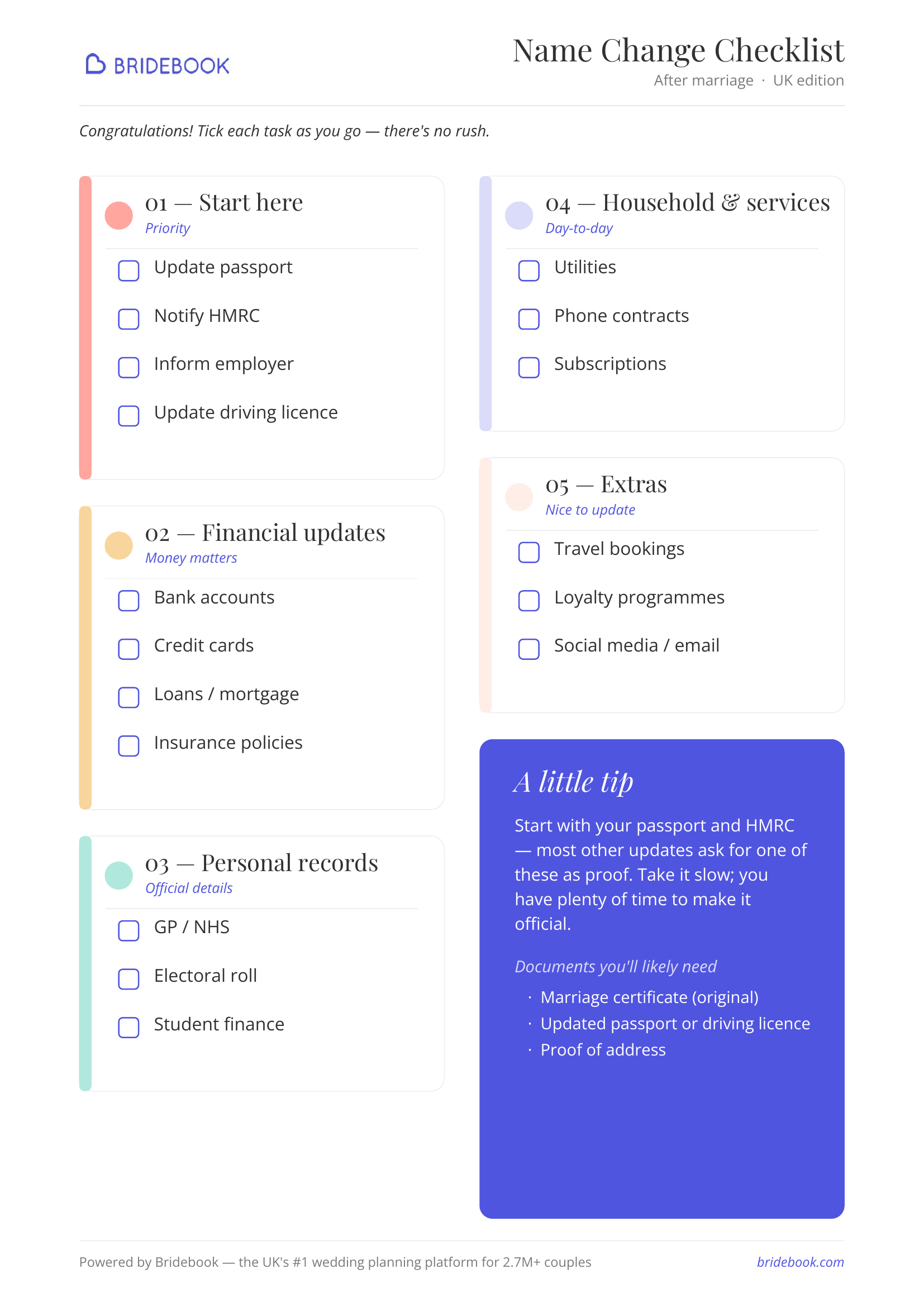
Changing your name after marriage checklist
Want to stay organised? Use this simple order:
Priority
- Passport
- HMRC
- Employer
- Driving licence
Financial
- Bank accounts
- Credit cards
- Loans/mortgage
- Insurance
Personal & services
- GP/NHS
- Utilities
- Phone contracts
- Electoral roll
- Subscriptions
Bridebook tip: Download and print our checklist so you can tick things off as you go – it makes the process feel much more manageable.
If you’re both changing your names
If you and your partner are:
- Double-barrelling
- Combining surnames
- Creating a completely new surname
You may need a deed poll name change.
Do you need a deed poll?
You’ll need one if:
- Your new surname isn’t clearly linked to your marriage certificate
- You’re creating a brand-new shared name
A deed poll is a legal document confirming your new name and is widely accepted across UK organisations.
Changing Your Name After Marriage FAQs
How long do I have to change my name after getting married?
There’s no time limit. You can change your name immediately after your wedding or years later.
What documents do I need to change my name in the UK?
Typically:
- Marriage certificate
- Passport or driving licence
- Proof of address (if required)
Do I need a deed poll to change my name after marriage?
Not usually. Your marriage certificate is enough for most standard name changes. A deed poll is only needed for more complex or custom names.
How do I change my name on my passport after marriage?
Apply for a new passport using your marriage certificate via GOV.UK.
Do I have to change my passport after marriage?
No – but if you plan to travel under your new name, your passport must match.
Does my partner have to change their name too?
No. Either, both or neither of you can change your name – it’s entirely your choice.
Admin sorted? It’s time to plan your honeymoon – check out the best honeymoon destinations in the world here.


